 |
Nork Youth Center Judo Group“Judo teaches to lose, unless you lose, you won’t win”, - says Vahe, one of the students of Nork Youth Center. “It teaches you to be flexible, to use your logic and persevere”.
|
 |
Students of Paris College “Dprotsaser (School-Loving)” in the Mother SeeEvery year, the students of the Armenian College of Paris “Dprotsaser” come to Holy Etchmiadzin with Sarkis Petrossian, the benefactor of the Armenian Church to receive the blessing of the Patriarch of All Armenians. Many of them are in Armenia for the first time.
|
 |
Holy Resurrection iconography in the Church ArtThe iconography of the Resurrection of Christ is one of the most common themes in the Church Art. Some of the best works are kept at the Museums of the Mother See.
|
 |
“Dark Bitter Chocolate”The play “Dark Bitter Chocolate” was premiered in Drama Theatre named after Hrachya Ghaplanyan. The author of the play is Emma Petrosyan.
|
 |
New books 21.04.2014The Armenian Genocide Museum-Institute presents to the Armenian reader for the first time the Eastern Armenian translation of the memoirs of American political figure Henry Morgenthau, eyewitness of the Armenian Genocide in 1915.
|
 |
Resurrection Sharakans performed by Geghard ChoirConductor and singer Anahit Papayan and the members of the Choir she established are famous for their performances of Armenian spiritual songs. They sing in Geghard Monastery, have concerts in Armenia and abroad. Gheghard Choir’s song list also contains h a number of sharakans dedicated to the Resurrection.
|
 |
Candlelight Divine Liturgy of Holy Resurrection in the Mother See of Holy EtchmiadzinThe celebrant of Divine Liturgy in the Mother See of Holy Etchmiadzin was Bishop BagratGalstanyan. Upon the termination of the Divine Liturgy the Patriarch of All Armenians voiced the Good Tidings of the Holy Resurrection. The flow of believers kept coming to the Mother See of Holy Etchmiadzin up till late night.
|
 |
Sharakans (Armenian chants): sources of the Armenian spiritual musicRecords on one of the richest strata of the Armenian spiritual culture, the studies of sharakans, as an independent branch, trace back as early as the 5th century in parallel to the invention of letters. “It is impossible to sing sharakans as an ordinary vocal piece”, - assures conductor Harutyun Topikyan.
|
 |
Year 2014– Year of SahyanDeputy Minister of Culture Artur Poghosyan presented the state event program to be held for the 100th anniversary of Hamo Sahyan.
|
 |
Confession and ReconciliationConfession and reconciliation are the key elements of the Christian faith. They are significantly absorbed into the Christian culture. Over time, the phenomena of confession and reconciliation started assuming a regulatory role in interpersonal relations too, thus turning into a norm in the social relationships. Why does the individual spiritual life assume the act of confession and how does it work as a regulation mechanism for the public life? The topic is discussed by Arshavir Gaboujian, program director of the Bible Society Armenia, and Pargev Ohanyan, lawyer and former judge. The conversation is hosted by Anna Sargsyan. |
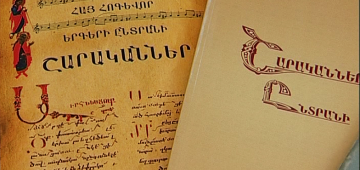 |
Spiritual song books in the Armenian ChurchSharakan books (sharaknots), treasuries (gandzarans) and song books (tagharans): why and how were they created, what songs does the Church consider to be canonical?
|
 |
Opening of exhibition “Classmates: 30 Years Later”Works of Fine Arts Academy students 1984-1990 were exhibited in the Artists’ Union under the title “Classmates: 30 Years Later”. Painting, graphics, sculpture, design, ceramics: around 150 works by 22 authors showcased at the exhibition.
|