 |
Mary’s Visit to Elizabeth (1:39-45)
Luke writes in the Gospel: Mary went with haste to Elizabeth to share her joy. And when she entered the house of Zechariah, she greeted Elizabeth, and the baby leaped in her womb. Immediately after these words, Luke says: Elizabeth was filled with the Holy Spirit and said, “Blessed are you among women, and blessed is the fruit of your womb.”
In the first chapter of the Gospel of Luke, verses 39-45, the visit of the Virgin Mary to Elizabeth is presented. Father Markos Mangasaryan comments.
|
 |
The Annunciation of the Birth of Jesus (1:26-38)
Luke the Evangelist says that the Archangel Gabriel came to Joseph, who was engaged to be married, whose name was Mary. The Evangelist emphasizes by this that they were not married. Hence, the Christian Church had to tell about the eternal virginity of the Holy Virgin Mary, the immaculate, without any trace of sin, coming into the world of Christ. How is the Annunciation of the Birth of Jesus presented in verses 26-38 of the first chapter of the Gospel of Luke? Father Markos Mangasaryan comments.
|
 |
The Annunciation of the Birth of John the Baptist (1:5-25) Part 2
John means “The Lord is gracious.” He must have been filled with the Holy Spirit from his mother’s womb, must not have drunk wine or strong drink, and must have been great before God. All of this describes one of the religious movements of that period, the Nazarene movement, whose representatives had such behavior and manners.
Father Markos Mangasaryan interprets verses 5-25 of the first chapter of the Gospel of Luke, where the Annunciation of the Birth of John the Baptist is presented.
|
 |
Judicial Authority in the Bible Part 2Why does the example of God's judgment imply forgiveness for all those who repent of their actions, including apostasy? Archimandrite Ruben Zargaryan explains. |
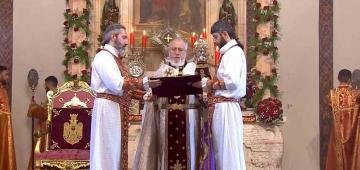 |
Easter in the World
On April 5, the Feast of the Holy Resurrection of Jesus Christ united Armenians around the world. The Catholicos of All Armenians celebrated the Divine Liturgy in the Mother Cathedral.
Celebrations were held in all Armenian churches. The Easter message of the Armenian Patriarch was read in all churches of dioceses around the world. The Patriarchal speech is a guide for Armenians living thousands of miles away from their homeland, as well as a call to use personal abilities for the national interest.
|
 |
The Annunciation of the Birth of John the Baptist (1:5-25) Part 1
Luke wrote his Gospel in a documented, accurate, and verified manner, but at the beginning of his Gospel he speaks of two great supernatural events, miracles, which are practically impossible to prove. The first of these is the episode of the Annunciation of John the Baptist, where he presents the appearance of an angel. The second is the episode of the meeting of Mary and the angel. Verses 5-25 of the first chapter of the Gospel of Luke are dedicated to the announcement of the birth of John the Baptist. Father Markos Mangasaryan leaves.
|
 |
Judicial Authority in the Holy Scriptures Part 1Jesus says, “Judge not, lest you be judged,” and adds, “With what judgment you judge, you will be judged.” Why should the court today be called to resemble the divine, heavenly court? Archimandrite Ruben Zargaryan explains. |
 |
The vow of ordination
What obligations does a clergyman assume during the ordination ceremony? How does the vow of ordination differ from the Christian vows and promises of an ordinary believer?
How does a clergyman express his commitment to keeping that vow, and what trials may he face?
The topic was discussed by clergymen of various ranks.
|
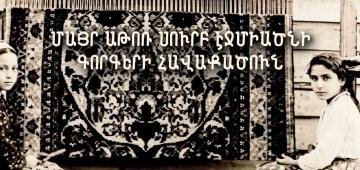 |
The Carpet Collection of the Mother See
For centuries, carpets have been kept in the treasury of the Mother See of Holy Etchmiadzin as cultural treasures. These carpets are not simply decorative objects, but eloquent witnesses of a culture. The collection of the Mother See was formed not as a result of planned collection, but as a result of time, donations and historical upheavals. Under the care of His Holiness Karekin II, Catholicos of All Armenians, the collection is currently being supplemented with the aim of becoming a complete material for a carpet museum in the future.
|
 |
Luke the Evangelist’s Prologue (1:1-4)
Who was the addressee of the Gospel of Luke, Theophilus, which means God-loving? There is a version that Luke, having been sent to Rome by the Apostle Paul, converted a centurion named Theophilus, to whom he later dedicated his Gospel. According to another version, Theophilus was the judge who was to pass sentence on the Apostle Paul and Luke wrote this Gospel to save his teacher. According to a third version, Theophilus is a collective figure and by saying Theophilus, Luke means all those who love God. Father Markos Mangasaryan interprets verses 1-4 of the first chapter of the Prologue to the Gospel of Luke.
|
 |
The Source of AuthorityWhy is the source of judicial, legislative, and executive authorities considered divine? Archimandrite Ruben Zargaryan explains. |
 |
Introduction
Although Luke the Evangelist was a physician by profession and a contemporary of Jesus Christ, he never had the opportunity to see Christ in person and follow Him. He becomes a colleague of the Apostle Paul and writes down the Gospel. The Gospel of Luke presents the easiest and most graphic material for the reader. It is a Gospel of prayer. Only in the Gospel of Luke are there the parables of the Unjust Judge and the Widow, the Good Samaritan, and the Prodigal Son. The introduction to the Gospel of Luke is presented by Father Markos Mangasaryan.
|